


As educators, you see the reality in your classrooms every day: students arriving with foundational skill gaps, carrying academic anxiety, and struggling to keep up with course demands. You don’t need convincing the problem exists – you are already deeply invested in solving it.
The question isn’t what is happening, but how we can build tools that give both you and your students the support you deserve.
Before joining the Product team, I spent 8 years in Quality Assurance. I often look at learning systems through a framework called the Cost of Quality (COQ). In QA, the goal is simple: spend time and effort preventing errors upfront rather than catching them after a product is built or dealing with late-stage failures. A meaningful investment on the prevention side reduces downstream failure costs tenfold.
In the software world, QA isn’t just about finding bugs before a launch. It’s about understanding the underlying systems that allow errors to happen in the first place. If we look at higher education through this lens, the message is the same: prevention beats remediation every time.
From “Appraisal” to “Prevention”
In traditional course design, high-stakes midterms and final exams act as the “appraisal” step. They audit knowledge, but they catch learning gaps after the learning window has closed. The resulting “failure cost” isn’t financial. It’s paid in student anxiety, course withdrawals, and faculty burnout from late-semester triage.
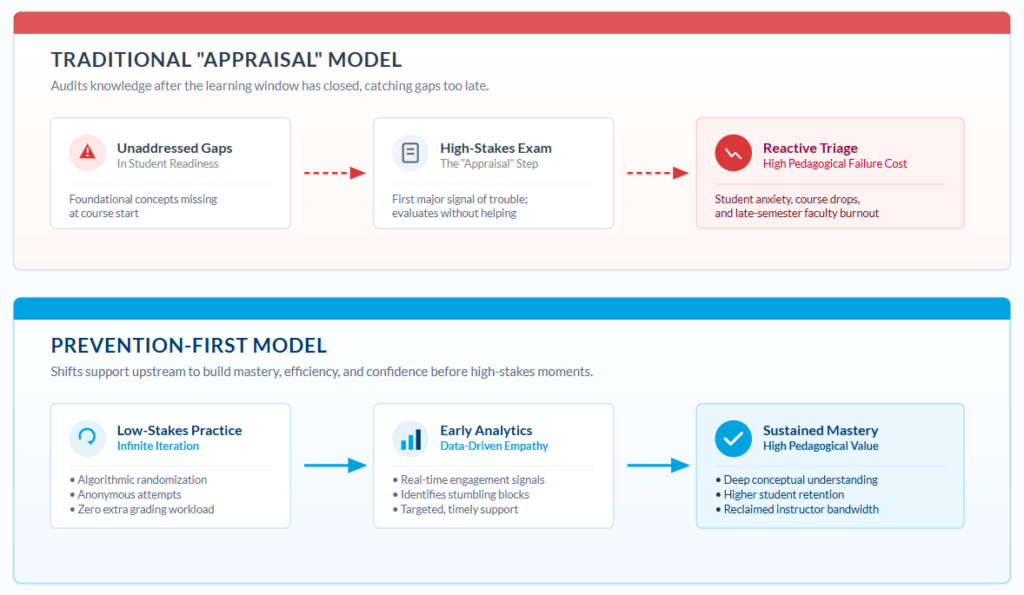
To break this cycle, we need to move support upstream, so students build proficiency long before high-stakes assessments arrive. Does prevention add more manual grading to an already overwhelming instructor’s workload? It doesn’t have to.
How We Are Building Prevention into Möbius
We design Möbius to make pedagogical prevention automatic, scalable, and low-effort for instructors, while creating a safe space for students to fail, iterate, and learn.
Algorithmic Practice & Infinite Attempts
True proficiency requires deliberate practice. Möbius allows instructors to deploy algorithmically randomized questions across low-stakes, proficiency-building assignment formats:
- Anonymous Practice & Flashcard Activities: Students interact with randomized problem sets without the pressure of an immediate grade penalty.
- Mastery Assignments: Students receive infinite variations of algorithmic questions, allowing them to attempt problems until they demonstrate true conceptual understanding.
Because these problem sets are dynamically generated and auto-graded, students get unlimited practice, while your grading burden remains low.
Early Diagnostic Visibility via Analytics
You cannot prevent a learning gap you cannot see. Integrated learning analytics in Möbius give you a real-time window into student progress well before the midterm:
- Identify Stumbling Blocks: Track class-wide accuracy trends and time spent per question to see where students lose momentum.
- Data-Driven Empathy: Use analytics not to monitor students, but to intervene with targeted support right when they need it most.
Partnering for Student Success
You are already doing the hard work of guiding students through increasingly complex learning landscapes. Our mission at DigitalEd is to build technology that supports your expertise. We deliver frictionless tools that reduce workload strain while keeping student proficiency at the center.
By investing in low-stakes, automated practice upfront, you can eliminate the heavy toll of late-stage remediation and build a clearer path to student success.
We’d love to help you build a smoother path to student success, so reach out to our team today to start the conversation!