


The Details
The Hague University of Applied Sciences Builds a More Flexible Flipped Classroom with Möbius
The Hague University of Applied Sciences (THUAS / De Haagse Hogeschool) educates over 25,000 students across four campuses in the Netherlands. Situated at the Technical Department on the TU Delft campus, THUAS focuses on practical application across technical disciplines including Mechanical Engineering, Mechatronics, Applied Physics, Manufacturing, and Applied Mathematics.
Abboy Verkuilen, a lecturer and researcher, joined the Mechanical Engineering department over 10 years ago following a background in Industrial Design Engineering and the bicycle industry. Driven by educational theory and digital pedagogy, Verkuilen sought tools that move beyond surface-level testing to support genuine mastery in technical courses.
When THUAS prepared to migrate its learning management system to Brightspace, Verkuilen faced a common dilemma: how to build long-lasting, flexible digital assessment materials that wouldn’t require constant re-authoring.
Standard LMS quizzes offered limited question types and few answer variations. In applied engineering courses, where students must perform multi-step calculations, analyze manufacturing processes, and interpret technical diagrams, basic multiple-choice formats were insufficient.
“We were using Blackboard, and I didn’t like the options you had for quizzes. When the news came that we were switching to Brightspace, I thought: I’m not going to invest time getting those quizzes into Brightspace. I’m going to build them in Möbius, because then I’m sure I can seamlessly use them anywhere.” -Abboy Verkuilen, Lecturer & Researcher, The Hague University of Applied Sciences
Having previously encountered Möbius during his time at TU Delft, Verkuilen recognized the power of its underlying math engine to parameterize questions and generate dynamic content.
Verkuilen integrated Möbius into a flipped classroom for his Manufacturing classes long before remote learning became mandatory. Before attending class, students watch short video clips and complete low-stakes pre-class Möbius quizzes. Rather than merely testing memory, these pre-class assignments include introductory scaffolding to guide students through new concepts as they answer.
“Because the quizzes are before class, they need to be questions that introduce students to the topic. Reading the question itself helps the students learn. When COVID hit, students told me: ‘Your class just continued, it was almost like there was no COVID.’ Everything they needed to learn was right there in the digital learning environment.”
One of the most innovative ways THUAS leverages Möbius is by linking its algorithmic engine directly to visual elements. Using HTML and dynamic vector graphics programmed inside Möbius, Verkuilen creates interactive engineering diagrams, such as Mohr’s Circle stress transformations, that visually recalculate and redraw based on each student’s unique algorithmic variables.
“What I really enjoy about Möbius is that you can get into the algorithm and program dynamic images in HTML. The graph is generated on the spot and slowly builds up. When a student refreshes or retries, the graph dynamically changes to match their specific numbers.”
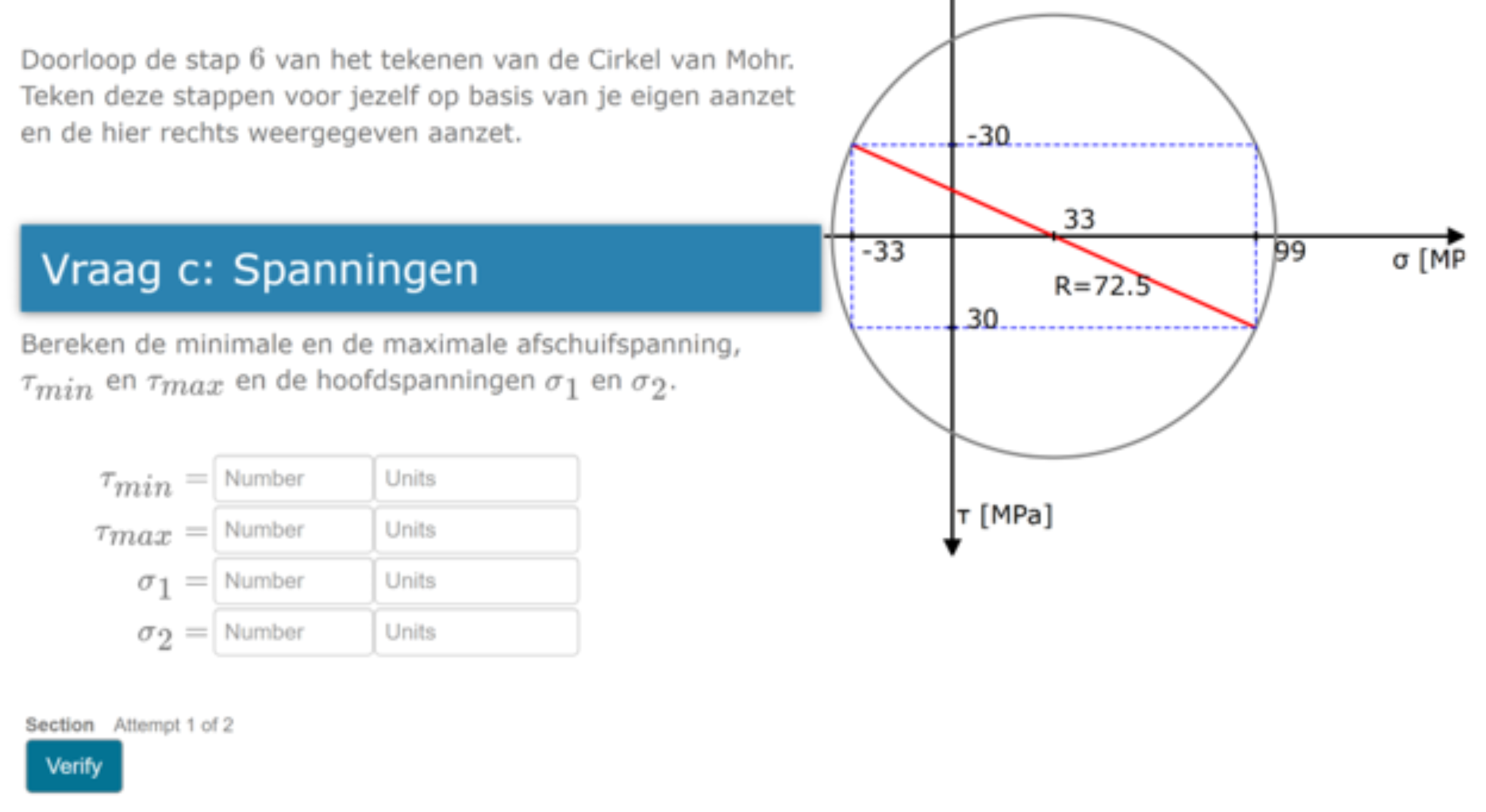
A sample question from Möbius that Abboy Verkuilen has integrated into their course materials through Möbius.
To help students master complex multi-step engineering problems, Verkuilen utilizes Möbius’s adaptive scenario-based question capabilities. If a student struggles with a high-level primary question, the system breaks the problem down into guided sub-questions to reveal the underlying problem-solving procedure.
“With scenario-based questions, I can ask a main question first to see if the student gets it. If they don’t, Möbius shifts to sub-questions first to ask for the procedure the student thinks is needed and then reveals the step-by-step procedure. I can pinpoint exactly what knowledge the student has and where they need help, while students who understand it right away can move on efficiently.”
For universities looking to transition from paper-based or basic LMS assessments to advanced digital assessment, Verkuilen emphasizes the importance of mentorship and reusable content:
“Get an expert user within the university who gets deep training and builds a solid library of starter materials. When faculty have a master set of question templates to copy and build upon, you can refrain from needing everyone to dive deep into code immediately. It makes it easy for any lecturer to start authoring right away.”
Whether you’re migrating from an LMS or looking to introduce active, algorithmic learning into your department, you don’t have to do it alone. Reach out to DigitalEd to discover how our Customer Experience experts support your team through seamless onboarding and custom implementation.