

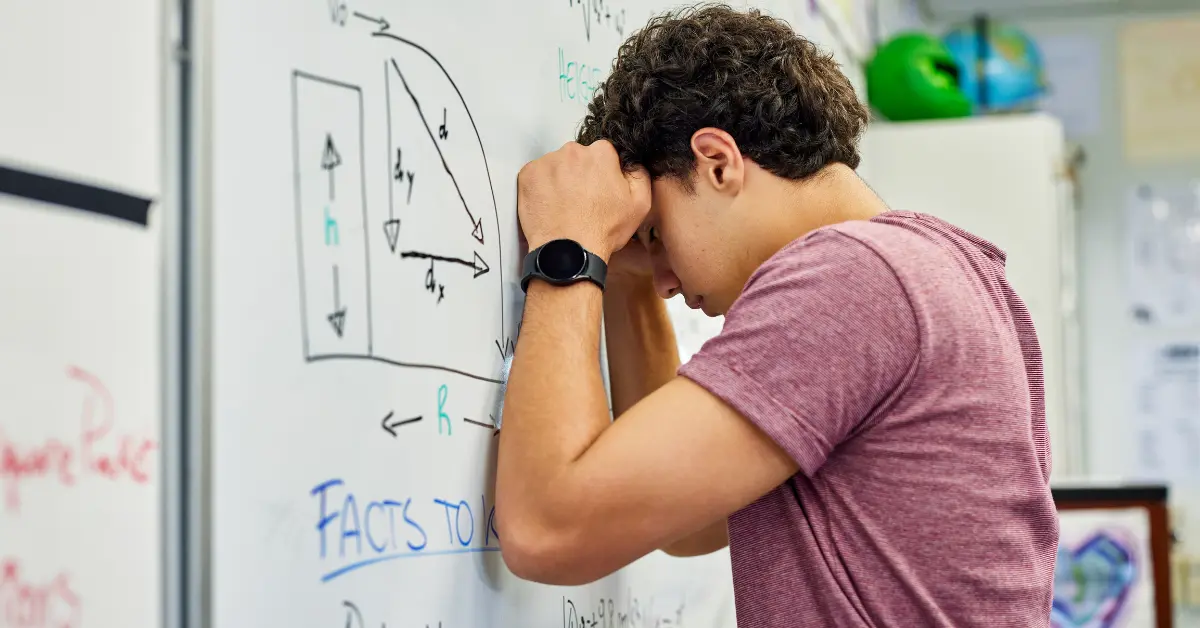
For educators teaching first-year or introductory mathematics at a community college or university level, the “readiness gap” is a familiar hurdle. Students often enter these courses carrying varying levels of knowledge and significant math anxiety. Research has shown math anxiety is linked to lower math performance. The challenge isn’t just teaching calculus or algebra; it’s about transforming a student’s internal narrative from “I can’t do this” to “I’m a math warrior.”
Möbius is designed to meet this challenge head-on with a dynamic, interactive environment that can improve student DFW rates and build foundational confidence.
1. Bridging the Math Readiness Gap with Precision
Traditional placement tests often tell us that a student isn’t ready, but they don’t always show us the why. (If you want to go deeper, we’ve shared more on bridging the math gap.) Using technology for math readiness assessments allows for a “surgical” approach to remediation.
- Diagnostic Precision: Möbius’ Math Readiness allows instructors to identify specific gaps, whether it’s fraction fluency or algebraic manipulation, before the first lecture.
- Adaptive Learning Pathways: Instead of a generic review, students follow personalized paths. This ensures they spend time only on what they haven’t mastered, creating “small wins” that are the best antidote to math anxiety.
2. Reframing Failure: How Low-Stakes Practice Reduces Math Anxiety
In high-stakes environments, a wrong answer feels like a dead end. To forge math warriors, we must decouple “wrong” from “failure.”
- Algorithmic Question Generation: One of the most powerful features of Möbius is the ability to generate infinite variations of a single problem. If a student fails a question, they can immediately “Try Another Version” for practice or low-stakes assessments.
- Low-Stakes Mastery: This creates a safe “sandbox” where students can struggle, fail, practice, and eventually succeed without the fear of a permanent grade penalty. This iterative process builds the persistence and resilience necessary for STEM degrees.
3. Visualizing the Abstract: Combating Math Anxiety with Intuition
Math anxiety often stems from the feeling that formulas are just “magic” to be memorized. Technology makes the invisible visible through interactive visualizations.
- Active Learning: When students can manipulate live elements on their screen to visualize math concepts, like those provided by GeoGebra, Desmos, Maple, or other solutions, students build an intuitive “gut feeling” for the math.
- Immediate Feedback: Real-time feedback loops allow students to self-correct during the learning process, preventing the cognitive “freeze” that happens when they get stuck on a homework problem at midnight. Research suggests that immediate feedback in online math practice helps students learn faster and build confidence—especially in introductory courses.
4. Scaling Support: Data-Driven Instruction
At the community college or university level, faculty are often managing large cohorts. It is impossible to manually track the emotional state of 200 students, but technology can help.
- Sophisticated Math Engines: Unlike simple multiple-choice tools, Möbius uses a math engine that recognizes mathematical equivalence. This means it understands equivalences, such as ½ and 0.5, sin(Pi/2 – x) and cos(x), (x+2)^2 and x^2 + 4x +4, reducing the frustration of “getting it right but the computer marked it wrong.”
- Identifying the “Silent Struggler:” Using the analytics dashboard, you can see which students are spending hours on a single module without progress. These are the students most at risk of dropping out. A timely, supportive email can be the intervention that keeps them in the course.
Forging the Future of Math Learners
The shift from “anxious student” to “math warrior” doesn’t happen by accident. It requires an environment that prioritizes readiness, active engagement, and the freedom to fail. By integrating platforms like Möbius into your first-year math curriculum, you aren’t just teaching formulas; you’re building the confidence and competence students need to thrive in the modern world.
Help your students shift from “I can’t do this” to “I can improve after practice.
Download our Math Anxiety Poster and share this tip sheet in your classroom or with your students.